Showing posts with label short walk. Show all posts

Sunday, 24 January 2016

Ice and Ancient Royalty

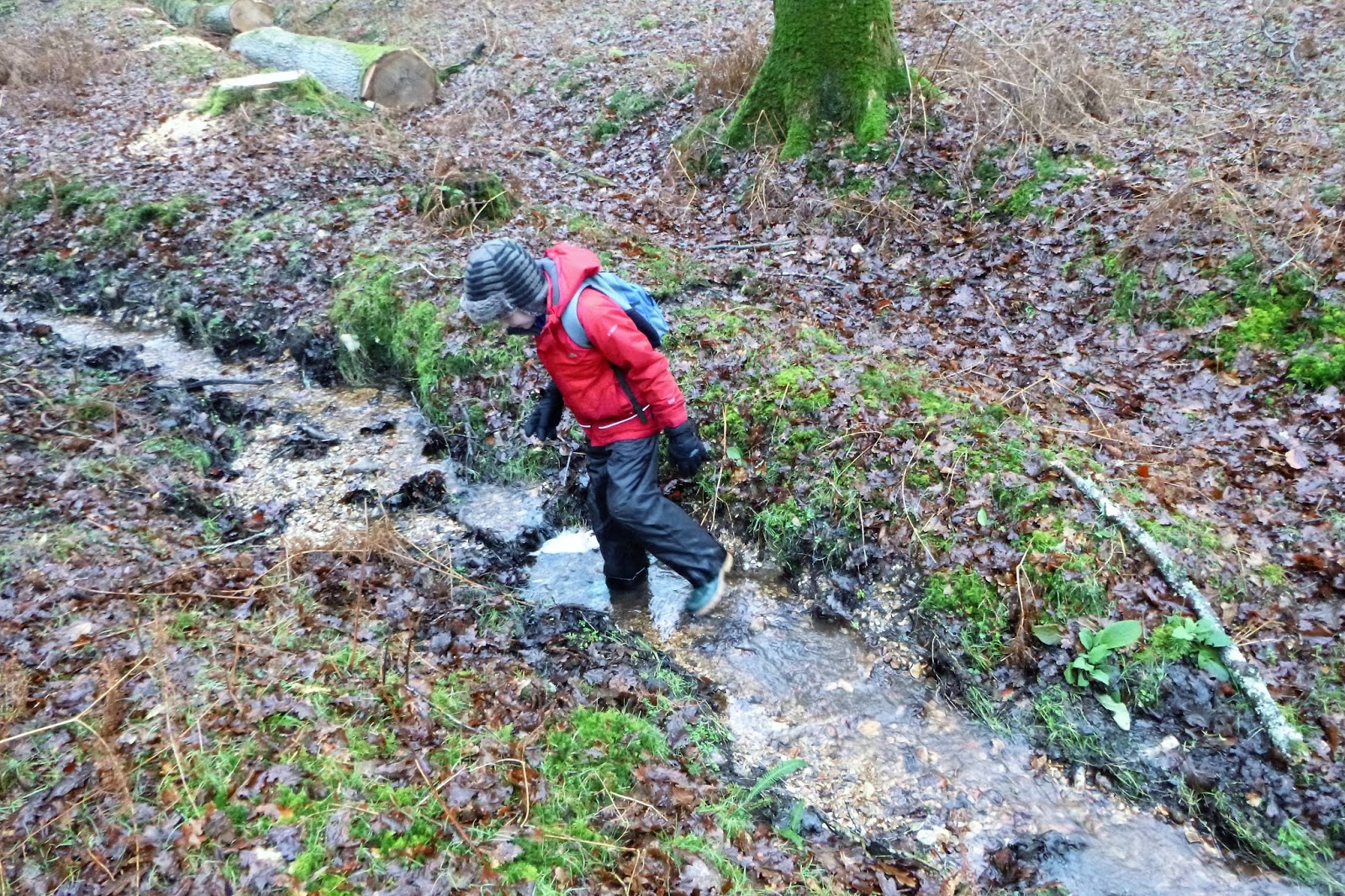
It had been raining hard, now it was freezing cold and the wind was howling, but a wise person once said that “there’s no such thing as Bad Weather, only inappropriate clothing!” With this in mind we layered up our clothing, got out our boots, waterproof jackets and trousers, located our hats and gloves and zipped out to the rain soaked bog that used to be the New Forest.
I always have a look at an Ordinance Survey map before we go for a walk. I normally try to find places along the route with quirky names, to amuse the children. My daughter once commented that I always take them to places named after the Devil, Hell or other gruesome things.* This is largely true but it’s not because I worship the Devil (I don’t).
On this little trip I  managed to find Deadman’s Hill, Claypits Bottom, Burnt Balls and the Butts (which did indeed made the kids laugh). I wanted to explore Studely Castle, the site of a royal hunting lodge. There are quite a few sites like this in the New Forest and they always seem to be in good locations - fit for a king, I guess. We did find the remains of the embankments and it commanded a great view. The children were duly pleased to know that kings had once tramped through the same sodden swamp that we had.
Once we got out of the woods the kids delighted in finding large sheets of ice, picking them out of puddles, then hurling them headlong to shatter, sending shimmering shards of ice, skittering across frozen water. Very entertaining! Their waterproof gloves were being sorely tested but it kept everyone happy and motivated to move on in the hunt for ice.
We only went as far as the Butts (a tumulus actually) before we felt the need for food and warmth, and started to think about heading home. Around here we found a nice frozen pond, which looked perilously dark and bottomless. We had to restrain the children from wading in too deep but it made a good full-stop for final ice smashing activities, before turning back along the boggy quagmire that was our path.

*As I explained to my daughter, this is due to the old Christian habit of renaming ancient pre-christian places of burial, worship or habitation as wicked or evil. Knowlton Henge is a classic example. Many churches were built on top of, or on the site of prehistoric antiquities, in an attempt to usurp the existing religious association. Twyford Church near Shawford was apparently built on top of a Stone Circle - and a Sarsen stone can still be found in the lane that leads up to it.  The Hell Stone is a Neolithic burial chamber and the Devil’s Coits is another Stone Circle.

Thursday, 26 November 2015

Russet, Rufus, Red, Green and Gold

We always enjoy Autumnal walks in the New Forest and one of our favourite places to visit at this time of year is Rufus Stone.
The towering Beech trees stand like sentinels, possible witnesses to the "accidental" slaying of King William the Second (Known as Rufus for his red hair) by Sir Walter Tyrell. Hunting mistakes do seem to be a common theme in medieval regicide.
We checked out the memorial plaque but we were not here for a history lesson so much as to wander amongst the mist wreathed splendour of the forest.
Every inch of the mossy, boggy landscape beneath our feet seemed turned to bronze by the falling leaves, while those remaining on the trees shimmered in the gentle wind.
A thin dappled sunlight glimmered through after our lunch time picnic, bringing an ethereal beauty to the russet and green glow
I don't know how many miles we walked, it must have been at least five but nobody seemed to notice the distance as we wondered at the view.
The children kept pace with us for most of the time and there was very little questioning about how far we still had to go. They were kept busy working out how to jump streams and negotiate bogs.
I think we timed it just about perfectly, both with regard to the time of year and the duration/distance of the walk because everyone still seemed deeply satisfied on our return. I even had the opportunity to gather another bag-full of Sloes.
Don't forget to put, the Urbane Forager book on your Christmas present list. 
Order your copy now!
You can buy this lovely book for your friends and family from all good book-stores or Amazon.
Author: Alan Gibson

ISBN: 978-1-78507-300-7
The best Urbane Forager images are now on Pinterest. Please follow & share.


Friday, 4 September 2015

Autumn Approaches

As September sneaks in under the radar, the evenings are getting cooler, the morning dew is getting heavier. We have been hunting for Hazelnuts and all the signs indicate that their will be plenty of them ripening imminently. The bright orange berries in the top picture are Rowan (Mountain Ash). They can be used to make a tasty seasonal jelly but obviously you should only pick them off a tree that you have clearly identified first.
Elderberries are already ripe and ready for gathering, I normally make a deep red, flavoursome wine out of our Elderberries but you can also make other products, such as syrup, cordial or jelly, which is said to stave off colds and illness as the nights draw in.
Crab-Apples are the only truly native Apples to be found in the UK, they are often found planted in grass verges in the city but can also be found in hedgerows. They are mostly ripe now and there is a whole host of things that can be done with these undervalued little beauties.  
We have also been checking out the larger Apples as they begin to ripen. Many of the trees we have investigated are over burdened with immature fruit. They will be ready for picking in late September or October but some early Summer Apples are ready to gather sooner.
Some people ask us to help harvest excess Apples from their gardens, we picked about 50 Kgs from one tree and these will either be added into our Winter storage or contribute to our juicing efforts. It will soon be time to dust off the trusty old Cider Press!
Diary Date: 
Sunday 13th September at 3:00pm
My friend Clare Diaper & I will be leading a free walk from Woolston Railway Station on Sunday 13th September 3:00pm.
Clare has written a delightful book on local walks from railway stations and we will be following one of her routes. The circular walk will take about 1.5 hours. En-route we will be pointing out and identifying many fruit and nut trees. 
Everyone is welcome and the walk will take us up through Peartree Green, essentially a steep hilly field, so wear appropriate clothing and footwear. Bring bags if you want to lug some of the oodles of apples available home with you, or you could just grab a couple as fuel, to sustain you until tea time. 
If you are coming on the walk and want a copy of the Urbane Forager book - please let me know in advance and I will bring copies with me.
Also, please take a few minutes to nominate me as a #GetOutside Champion. Email getoutside@os.uk with a few words explaining why Alan Gibson (aka the Urbane Forager) would be a great ambassador. Include links to this blog and your favourite pictures from here too. 

Friday, 20 September 2013

Hardy to Hellstone

We were making the most of the late-summer sun, camping at the lovely Ewleaze Farm in Dorset. I have always wanted to walk the whole South Dorset Ridgeway; it is a stunning prehistoric landscape, but past experience leads me to believe that the kids would collapse, without a constant supply of ice lollies.
Being a card-carrying Luddite, I don’t yet own a sat-nav but I do love paper maps, and often find interesting looking places and routes via the Ordinance Survey. We plumped for a short, but exciting walk from the Hardy monument to the Hellstone. I always like an accompanying legend to regale the kids with along the way, and the Hellstone’s Satanic designation comes from a local tale, telling of Lucifer Himself, hurling huge stone Quoits from Portland Pike! It is actually a Neolithic burial site.
The Hardy monument was constructed to commemorate Captain Hardy, of the good-ship Victory (Kiss me Hardy!), as opposed to the writer, Thomas Hardy, who also lived in Dorset. The monolithic tower commands spectacular views, with Chesil Bank and Portland Bill to the South, Maiden Castle to the East, and apparently five counties in other directions. A stiff wind was blowing off the sea, when we arrived, it was clear and sunny though, once the morning mist had burned off.
We checked our compass, with the friendly chap who was selling tea and him Mum’s tasty cakes, from a caravan in the car park. He directed us in a generally South-westerly direction and said it should be an easy trip, mostly down established footpaths. The wind was cut off as soon as we descended into the heather and bracken of the coastal path. Shortly everyone was stripping of layers and tying them round their waists or cramming them into my tiny rucksack; it wasn't long before we spotted our first sign.
The walk was rapidly turning into a sweltering stumble, so it was just as well that it wasn't too far. Fortunately the march was staggered (quite literally) by frequent pauses, to scoff copious amounts of Blackberries. We knew we were close but were short on clues, when my son stopped for a quick rest... Then we suddenly spotted a mossy stone carved with the epitaph, HELLSTONE ONLY.
Filled with renewed vigour, we scrambled over the wall and through the field, to our target. En route, I had told my son that treasure hunters had occasionally found gold or swords at sites of antiquities such as this, and as he scrambled on to the top of the Hellstone, he was duly delighted to discover £1.22 in coins that had fallen out of a previous visitor’s pocket.
We ate our picnic and before we headed back down the lovely path, I left a couple of coins on the top of the stones, in the hope that it might delight another caller to this haunting place. This was a pleasant, walk along established footpaths. The route leads through heath, farm and woodland, with just enough navigational and landscape challenge for the children. The Hellstone itself is a spectacular monument, tall enough for and adult to stand inside and craggy enough to enable kids to climb onto the roof. I always get a deep and romantic sense of ancient belonging when I visit these places. The remarkable Hellstone proved no exception.

Monday, 14 January 2013

Spitting into the Wind at Hurst

Brent Geese Flying South, Possibly to Avoid Becoming Xmas Lunch
Well folks, for me personally 2013 has, so far, proved a long way off satisfactory. Hopefully things will begin to improve, as time goes by. But enough of my woes, I have a popular blog to maintain. Winter/Spring is always a lean period for foraging but we still love to get out amongst nature, and hope to inspire you to get outdoors, for a walk with your family.
Hurst Spit and Keyhaven Salt Water Lagoon
Much to the children's disappointment, it has not yet snowed where we are. Mind you, we rarely get snow settling in Southampton, even when it is forecast for the area. I always blame this deficit on the hot rocks that lie beneath the city; they are used as a source of geothermal energy to heat part of the city. People never believe me when I say that Southampton used to be a Spa town, but it was.
The Needles, off the West of the Isle of Wight
We have managed to get out and about a bit though, and we had a very exciting and stormy walk on Hurst Spit. Hurst Spit is a massive shingle bank that has been thrown up by the constant action of the elements. It is the closest part of the mainland to the Isle of Wight and has long been a strategic military point for the defence of the Solent seaways to Southampton and Portsmouth. The castle at the end of the spit was built by King Henry the 8th in 1544 and King Charles 1 was imprisoned there in 1648 before being executed. 
Hmmmm!
More important these days are the large tidal lagoons of Keyhaven, behind the spit, a refuge and harbour for  many small boats and also an important nature reserve and bird sanctuary.
In the Shade (and Lee) of the Spit
When we arrived the Spring Tide and wind had caused the road to flood but we chugged through and found somewhere dry to park. The fist thing that was apparent was the force of the wind, the car was being buffeted all the time.
Some Would Say We Are Crazy - We Would Disagree!
We donned our wet weather gear to shield us from the storm and set off to test ourselves against its power, it was incredible. The waves were smashing into the shore and several times spray and spume breached the vast barrier to soak the few brave walkers. 
Milford, Battered by the Storm
We decided that it would be too exposed to trek to the fort and lighthouse, and chose instead to go the other direction toward Milford. We saw many flocking birds including Fieldfares (I think) in the corn fields where we parked. I could watch birds doing this all day, it is just fascinating how they all change direction at the same time. 
The Brilliant Brent Geese Treat us to Another Honking Fly Past
The highlight for me though was when a vast flock of Brent Geese, that had been grazing on a field, took off as one and wheeled around honking, doing a few laps of  the lagoons, before settling in a different part.

Friday, 23 November 2012

Deadman’s Plack: Skulduggery in Harewood Forest

Ever since watching a charming documentary on the A303; I have wanted to hunt down the Deadman’s Plack. I have frequently travelled the length of the A303 but urgency has often prevented me from turning off and exploring. The evocative name of this monument was enough to pique my interest but the legend behind it is even better and gives a fascinating glimpse of the intrigue constantly underpinning England’s monarchic history.
Autumn is always a good time for an adventure and a vague objective makes it more interesting (I knew our target was somewhere in Harewood forest). If you know where you are going, the trek to the monument from the road is actually a short walk through mixed woodland. We did not know where the path was though, so we took a rather scenic route and arrived, more by luck than judgement.
The memorial, in many ways reminiscent of Rufus Stone, is constructed from stone and has a large plinth supporting a tall cross; it was thoughtfully commissioned in 1825, by the entertainingly named Colonel William Iremonger. The inscription on the front is much worn and states the following epitaph.
About the year of our Lord DCCCCLXIII (AD 963) upon this spot beyond the time of memory called Deadman’s Plack, tradition reports that Edgar, surnamed the peaceable, King of England, in the ardour of youth love and indignation, slew with his own hand his treacherous and ungrateful favourite, owner of this forest of Harewood, in resentment of the Earl’s having basely betrayed and perfidiously married his intended bride and beauteous Elfrida, daughter of Ordgar, Earl of Devonshire, afterwards wife of King Edgar, and by him mother of King Ethelred II, Queen Elfrida, after Edgar’s death, murdered his eldest son, King Edward the Martyr, and founded the Nunnery of Wor-well

To modernise…
King Edgar (the peaceable!) sent his friend, Earl Athelwold to determine whether a local lady Elfrida, who was said to be very beautiful, was a suitable marriage candidate (for the King). On meeting the striking Elfrida, the devious Athelwold was so besotted that he neglected to explain his mission to Elfrida’s folks, and accidentally married her himself. On returning to report to King Edgar he explained that she was quite plain and unworthy of his royal highness.
Probably suspecting dishonesty, Edgar arranged to meet Elfrida himself. Fearing detection, Athelwold begged Elfrida to look dowdy and dull for the visit but she ambitiously made herself as glamorous as she could for the King. Athelwold was subsequently invited on a hunting expedition, in Harewood forest, where he received a complimentary javelin in the back for his troubles, with thanks from King Edgar, who promptly married his gorgeous widow Elfrida.
Subsequently, the King and his new Queen had a son Ethelred, half-brother to the Kings eldest Edward. Shortly after Edgar’s death Ethelred and Elfrida were suspiciously close at hand when Edward was murdered by his retainers on another hunting trip near Corfe Castle, his body was apparently left in a bog, for over a year. Ethelred (later known as the Unready) then acceded to the throne but showed his Mother such lack of gratitude for her support, that she beat him senseless with a large candle! So ferocious was this beating, that he feared candles into later life. However, when he came of age he was avenged by banishing his Mother, who, in an act of apparent penitence, established a nunnery at Wherwell on the Test River, close to Harewood forest.
Many a penknife has been blunted over the years by (possibly sympathetic) visitors carving their own monograms into the ancient stone base. Next to the Deadman’s Plack, someone had also built a nice den out of long sticks, which the children immediately made a temporary camp in.
Both my daughter and son were armed with cameras that they recently received as birthday presents and they were snapping every interesting looking tree, branch and leaf they came across. I might let the kids take over this blog at some point; a child’s eye view of our winter trips could make an interesting diversion.

Wednesday, 17 October 2012

Telegraph Hill

Telegraph woods has a wonderful avenue of coppiced chestnut trees there are also pine trees and broadleaved oaks.

Towering Chestnut Trees
The woods also play host to an old Armada beacon and an even more ancient Iron Age hill fort. A diverse and truly fascinating landscape all tucked away in one small spot.

Coppiced Avenue
It is a handsome and intriguing place for a short autumnal walk and also a great place to collect Sweet Chestnuts. In places an eerie quiet descends, all sound muffled by the pine needles.
Eerie Exposed Root Systems in the Fort
Always be prepared; bring boots stout gloves and bags or a coat with big pockets.
Steep Banks of the Enclosure Now Pine Covered
Your main competitors will be the vast number of squirrels that inhabit the wood as well as the noisy jays.

A Fairytale Vista
Fill the coat pockets with your brown beauties and collect a few dry sticks while you are there.
A Squirrel's Breakfast Table
Then you can use the twigs to build a little fire to warm your extremities and roast your nuts on when you get home.