Showing posts sorted by relevance for query walnut. Sort by date Show all posts

Monday, 26 September 2011

Walnut Wrangling

Folowers of the Urbane Forager keep saying to me things like,
“Apples/Pears, yada, yada, yada! When are you going to take us walnut picking?”
I’m paraphrasing of course but you get the gist.

Walnuts are very healthy to eat and according to nutritional scientists, they are the king of antioxidant supplying food stuffs. They can be used in a myriad of recipes (including a forager’s family favourite - Chocolate Brownies). In the Middle-Ages, Europeans believed walnuts would prevent illnesses, witchery, malevolence, and even ward off lightning.
It Is A Very Big Walnut Tree
My daughter and I zoomed over to our favourite tree, to check out the seasonal scene and YES, the walnuts were ripe, at last they are dropping! This is a huge tree, bang in the middle of town and you will always get competition from the local children when picking walnuts; there were plenty of sticks on the ground which had been previously used to throw up. Last year we collected about 16Kgs of walnuts in two quick trips to this tree.
Fill Your Boots - Well OK, Hat Then
We bagged a quick basket-full but there are still piles more up there just waiting to ripen or for a good wind to give them a good shake-down.
Ripe Walnuts
The big tree is not on my map at the moment J but some other walnut trees are. This one is in the middle of a residential area – so probably not good for a big gang to descend upon. There are many other walnut trees about the place, you need to be able to recognise their distinctive leaf pattern (a bit similar to ash) and then keep your eyes open to locate them, unless you notice the crunching of shells underfoot. I have seen them in Chandlers Ford and of course in Walnut Avenue in Swaythling.
Walnuts and Plenty of Them
However, if anyone is interested in a Walnut Picknik– I think I know the perfect venue. I need to check first but sign up here if you wish to enlist – be warned though it will require a steep walk up a grassy Iron Age hillfort...

Thursday, 2 August 2012

Cherries, Green Walnuts & Medlars


On our journey back from our walk at Bolton’s Bench recently, I spotted a big cherry tree by the roadside. I thought it must be worth a visit as I noticed the red fruit despite the rain streaked car windows.
The Cherry Tree
When the children and I returned to check it out, the skies darkened and it started raining, AGAIN! We had our waterproofs with us though and set out to try the cherries regardless.
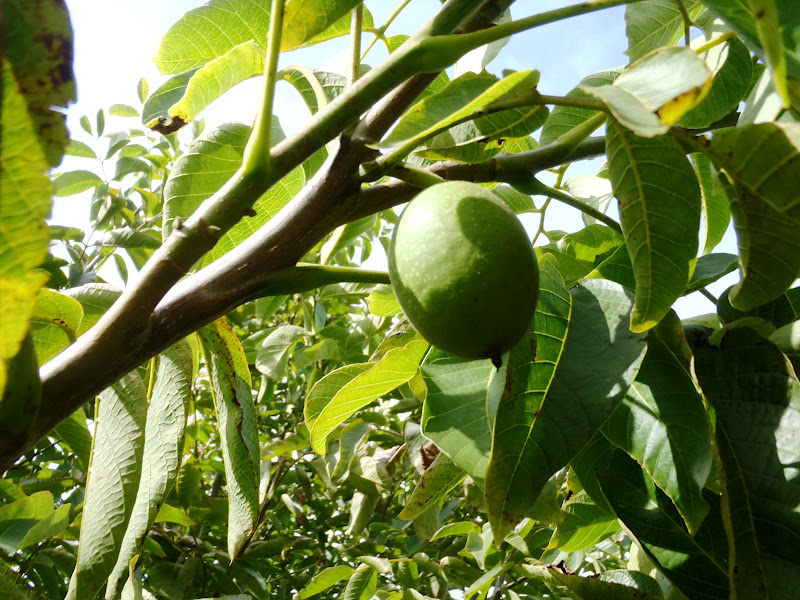
Green Walnuts
As we crossed the road to where I remembered the tree was, we found two beautiful little compact walnut trees, one of which was covered in (yes you guessed it) green walnuts. I grabbed a couple off the tree to take home, I love their exotic smell.
Sadly the cherries were, although bountiful, somewhat sour and not quite ripe. Also the tree had curling leaves, which seems to have become a big problem for cherry trees this year.
Walnut Catkins in Spring
The disappointment of the cherry was more than made up for by the walnuts though. Many people have expressed an enthusiastic interest in walnuts and these trees are actually fairly common.  I will arrange a Walnut Picknik when the season is right. Keep a keen eye on the blog for dates, places and times.
A Large Walnut Tree
To help with identification I had produced a seasonal tree id sheet for walnuts to go with the others. However, I noticed during my Arthouse Cafe talk that one picture on it was of a plum! This error will be corrected soon and you may want to replace the sheet if you have downloaded it previously.
Medlars
There is a small walnut tree in Watts Park (Southampton), that’s the one in front of the Art Gallery; location and examining this tree will help familiarise you with the leaf shape and pattern. Interestingly, there is a Mulberry tree in this park too. 
Medlars Also Known as Cat's Bottoms (seriously)
There are also several large walnut trees in Mottisfont for those who are members of the National Trust and on our last visit, I even spotted a Medlar too. Not that I am suggesting anyone goes foraging on National Trust land!

Tuesday, 25 September 2012

Walnuts & Water Walk


A Big, Fat, Green Walnut
This is a lovely walk that we did with family and friends, the children coped well and there was lots for them to do along the way. The route is approximately five and a half miles through fields, footpaths and bridleways.

I planned this route chiefly because I was inquisitive about Walnut trees. On a previous adventure (last year), we found a proliferation of Walnuts on St. Catherine’s Hill and I had heard rumours of further trees along the Pilgrim’s Path, we were not disappointed.
We counted well over 20 Walnut trees over the course of our exploratory search! Some were small and many were massive. Lots of people seem fascinated by these versatile and healthy nuts, so now you'll be able to spot some.
A Tiny Hedgrow Walnut Tree
We parked our car at the foot of Shawford Down (a great place for sledging in the snowy weather). You can get a train to Shawford station.

A Massive Mature Walnut
We set off from near the Bridge Inn, the footpath heads North, up the Itchen Navigation Canal from Shawford.

Lovely Shawford Lock
When you reach Shawford Lock, you can always stop to cool your feet (or even more of you) in the river. It is a most delightful spot and when I was a boy, my friends and I used to cycle here to go swimming during the long, hot summer holidays.
A Fat, Green Walnut - Almost Ripe
We crossed a small wooden bridge and headed NE, over a field, on a footpath.
After crossing the Itchen River via a bridge, we headed up the road to Twyford village. We crossed the main road as we reached it and carried on up a track leading to a farm. Part of the way up this track we bared left onto a path that crossed it and headed North over Twyford Down. This is a bridleway that edges around Hockley golf course.
Along this path we collected and ate enough Blackberries to sustain an army of ramblers. There was even a danger that the children might not be hungry enough to eat the picnic. Eventually though, the route joins the Pilgrims Path at a crossroads. At this junction, we stopped for our picnic as it seemed about halfway.
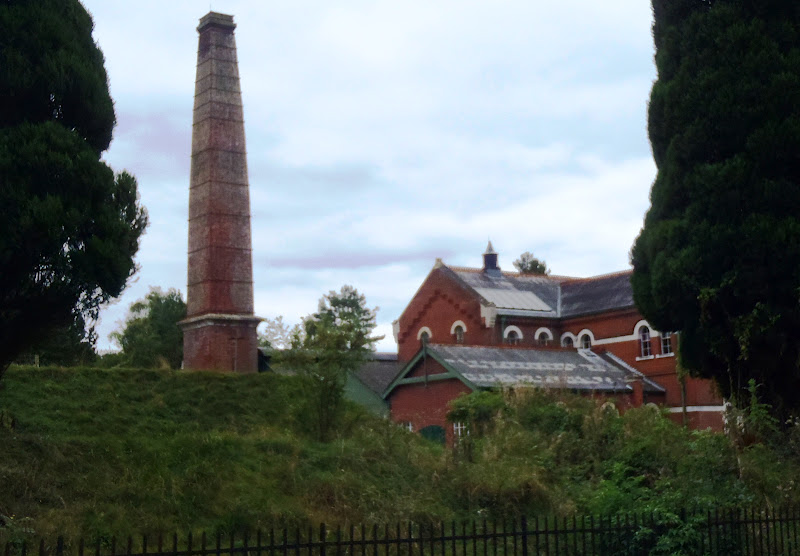
Twyford Pumping Station
We turned right and headed South, on the Pilgrim’s Path, all the way down to Hazeley Road. We then turned right and headed roughly West for a while along Hazeley Road. You pass, on your left, the Twyford Pumping Station, an imposing Victorian brick building with a large, square chimney left over from the days of steam power. This station has frequent open days and still supplies a lot of the local water from subterranean aquifers.
Evidence of an Indian Summer - Unseasonal Elderflowers
Eventually we noticed a footpath way-marker, which indicated a diagonal route over a corn field, this was known as the Kingfisher’s Path. The corn had been harvested recently and there was lots of straw left in the field, so a hay fight was almost inevitable… The path continues past and even through some gardens and on into Twyford village, where we crossed the main road and headed down Church Lane (opposite).
Guess Who's Going To Look Like Wurzle Gummidge Shortly?
Just before the river we found two large Sarsen stones on the left of the track. These were originally part of a  circle of twelve standing stones; local lore has it that this ancient place of worship was built by a druidic tribe in the Pre-Roman era. The remains of the circle are now mostly buried beneath the foundations of Twyford’s Virgin Mary Church. These two sole survivors are all that remain visible now, by the roadside.
A Small Pagan, Possibly
We then discovered a rope swing over the river Itchen and once we had managed to prise the children off it, we headed back across the fields to Shawford Lock.
Shawford Lock Open-Air Gym
We sat by the lock for a while, to rest our weary soles and soak up the late summer atmosphere, before finally trotting back down the Itchen Navigation to Shawford. In Shawford village, if you deserve it, you can get a drink of ale or food at the Bridge Inn.


Monday, 4 July 2011

Green Walnuts

It’s always best to leave most of the walnuts until they ripen, in the traditional way. They will keep for half a year or longer in their shells as long as you keep them in a cool dry place. We used them to make chocolate brownies, lots of other cakes and a very healthy trail mix.
A Ripe Walnut, Ready to Drop
Everything about Walnuts seems to require an unfeasibly large reservoir of patience. If you pickle them now, it is a three week process and then they should be ready in six months, just in time for Xmas. If you make Walnut Schnapps, it should be ready in about a year (or five). So it may be a nice present for Xmas next year at best.
Good Things (Walnut Schnapps) Come To Those Who Wait
 You can make Pickled Green Walnuts from the unripe fruit, preferably around June, as long as the hard nut has not yet formed. They are known as the King of Pickles. I don’t know why this is; I made some last year and they were not even vaguely princely. Always wear rubber gloves when preparing green walnuts otherwise the juice, which is a natural dye, will stain your hands and clothes brown.
Green Walnuts - They Smell Exotic Too
Ingredients

1.8kg fresh young walnuts
215g salt
950ml malt vinegar
470g packed dark brown sugar
1 teaspoon ground allspice
1 teaspoon ground cloves
1/2 teaspoon ground cinnamon
1 tablespoon freshly grated root ginger

Method
1.            Pierce each one of the young walnuts all over with a sharp fork or darning needle. Place the walnuts into a bowl and fill with enough water to cover. Stir in the salt to make brine. Put a plate on top, to make sure they are submerged and soak the walnuts for a week. Drain the mixture and make the brine again. Soak for another week.
2.            After the second week, drain the walnuts and lay them out on racks to dry in a sunny place. In 3-5 days they will turn black. Once they have all turned black, they are ready to pickle.
3.            In a large saucepan, stir together the malt vinegar, dark brown sugar, allspice, cloves, cinnamon and ginger. Bring to boil and then add the walnuts. Simmer over medium heat for 15 minutes. Remove from heat and allow to cool.

4.            Spoon the walnuts into sterile jars and fill with the syrup to within 1 cm of the top. Seal with lids and rings. Store in the refrigerator or sterilise in a hot water bath for 10 minutes before cooling to room temperature and storing in a cool dark cupboard.
I also made some Walnut Schnapps. In Denmark this is seen as the very best type of Schnapps and it certainly is a singular liqueur. It starts life as a strange looking, emerald infusion, which gradually turns a deeper green.
The Early Stages of a Lengthy Process
Later it changes into an oily black/brown liquid and the final stages it turns a deep mahogany brown.
Recipe:
  • Cut 5-6 large unripe walnuts (picked around July) in quarters.
  • Put them in a clean glass jar with tight-fitting lid.
  • Cover well with clear, unflavoured vodka - 40% (80 proof). Leave some air above the vodka.
  • Steep for 5 months - in a dark place at room temperature,
    18-20°C (64-68°F).
  • From time to time, or at least once a month, shake lightly with the lid off the jar - or stir with a spoon - to allow some oxydation.
  • Strain and filter your infusion into a clean glass bottle or jar with tight-fitting lid.
  • Store for at least 7 months in a dark place at room temperature before serving.
N.B. The longer you store your walnut schnapps - up to 5 years or even longer - the better it gets.
  • Finally filter once more.
Always Wear Rubber Gloves!
The taste changes radically as the drink matures and (after about a year) it ends up as a tasty after dinner dram, something to be nipped sparingly with good friends. If it tastes too strong, it can be diluted up to ten times with more of the plain vodka base, according to taste but you will need to leave it a couple of weeks further to properly infuse.

Having said all of this, and tried a few ideas; I think you should leave walnuts on the tree to ripen. They are much nicer and you can do far more with them this way.

Monday, 11 July 2011

Walnut Whip-Round

I seem to be inexplicably tuned into walnut trees at the moment. It must have been something to do with my recent blog entry. I'm now seeing them everywhere I go, they do look distinctive though and have a unique leaf pattern. It's strange, I though these trees were exotic and now I realise that they are fairly common - I just didn't recognise them before.


As I mentioned in the post Cider Inside 'Er Insides There are also walnut trees in Walnut Avenue (Swathling), although you can only collect nuts from the trees on public ground unles you get permission.There are also trees in Chandlers Ford and I know at least one in the Southampton parks.

Walnuts On The Tree

Most people only eat walnuts at Xmas, but they are a very healthy food and can be used in all sorts of cakes and breads. Our last batch has kept very well (they must be kept dry) and we still have a few left from our 2010 haul.

Yet More Apple Trees

I noticed a lot of apple trees in the wayside too and frequently saw flashes of yellow and red plums in the hedgerows, which just goes to show that the area where I live and work is not some kind of freakish Garden of Eden...

You need to look - but you also need to see!
Walnuts and Their Singular Leaves

I had to travel to Bury St. Edmunds this weekend (no, I didn't cycle). On the way out I noticed an immature tree on the airport roundabout. We stopped on the A11 for a break and there was a huge walnut tree over hanging the car park. On arrival at our destination in Bury, we had a short walk to stretch our legs and I spied yet another big tree laden with fruit.
These Walnuts Have Their Own Guard Horse

Wednesday, 5 October 2011

The Coincidence on St Catherine’s

 
A Small Walnut Tree Atop The Hill
We had heard reports of walnut trees on St Catherine’s Hill near Winchester and our nut gathering had been met with some serious competition from the local kids on the town trees. So, on an unseasonably hot October day, we set off to explore the ancient hill fort and see if we could find a new supply.
A Good Day For a Stroll In - Plague Pits Valley!
The first obstacle to our expedition was that the small car park by the river Itchen was full – I have heard rumours about plans by Sustrans (the cycle network) to reopen the Victorian viaduct for bikes. This would be a massively ambitious project but could create a fantastic cycle track down the old railway route.
The Steep Embankments Can Be Quite Challenging
In the event we managed to squeeze in via the tradesman’s entrance and walk up past the Donga’s traveller camp, which is next to the reservoirs at the back of the hill. Their tarpaulin/tent dwellings and old vans with wood-burning stoves are a window into a very different way of living; it does not look at all comfortable to me but they do have a very big garden, even if it is called Plague Pits Valley. I am pretty sure that they don’t have to pay council tax or have a mortgage to worry about though.
Crowning Glory of Beech
On a hot day the walk up St. Catherine’s can be hard work but all the effort is always well rewarded when you reach the summit.
Children Marching the Mysterious Mismaze
Once you get to the top of the hill, stunning views over Winchester open up. The brow of the hill is crowned with a circular clump of glorious beech trees. There is also an ancient turf labyrinthine pattern carved into the hilltop called the Mismaze.
I Spy Apple Pie!
While the children zoomed about the Mismaze – I scuttled off to examine a couple of suspiciously walnut-like trees I had seen. They were indeed walnuts but they had been picked dry, presumably by the travellers – no nuts, never mind!
One of the Large Walnut Trees on St Catherine's Hill
However, it didn't take long before my Fruit Radar picked up tasty looking red apples on a small briar covered tree; if only I had brought my fruit picker with me. I got stung and prickled a fair bit but managed to get a few apples into my bag and they were lovely to eat with the blackberries.
Ready to Run Downhill...
Then, in a weird moment of synchronicity (strange things often occur atop prehistoric hillforts), we chanced upon someone I had worked with by email but not met in person. Chris is a freelance designer who was employed on my latest martial art book project Wing Chun: the Works.
Cooling Our Jets In The Itchen River
On the way down the hill we crunched on the foraged apples and found several more large walnut trees, all of them with no trace of nuts but definitely worth remembering for visiting (earlier) next year. Finally we cooled our hot feet in the soothing waters of the river Itchen before grabbing a few hazelnuts on the way back to the Dongas.

Ooh! That's Better.

Monday, 22 June 2015

Summertime Foraging Fun

Summer is finally establishing itself in Southampton. We went for a meandering walk with friends along the river beautiful Itchen. I was pleased to spot a nice looking apple tree by a car park in Shawford before we set off; I duly added this to the Falling Fruit map. The atmosphere was heady and the smell of Elderflowers hung heavily in the air.
The route took us up-river past Compton Lock, which is always a fabulous place for a fun swim. We used to cycle to this spot during teenage summer holidays. 
We passed under the M3 motorway and watched swooping swallows catching bugs under the bridge. Despite the wonderful countryside surrounding us, the kids seemed to enjoy being under the massive bridge and hung around here for some time. 
Then it was a short but extremely steep climb up the ancient hill fort of St Catherine’s with the sunshine hammering down from above. The view over Winchester and the water-meadows is truly spectacular. 
We saw several Walnut trees, some of which seem to have had the ends of the branches somehow damaged. People had been having fires on top of the hill amongst the beeches, which must be nice, but some idiots had been setting a fire in the bowl of one of the largest trees – It is difficult to believe the stupidity of this action.
I also noticed a couple of Juniper bushes clinging to the steep ramparts. I have seen Junipers at Figsbury, Danbury and Winchester Hill forts. We found Walnut trees at Badbury Rings as well as here. Walnut (and Apple) trees were introduced to Britain by the Romans and Juniper is thought to be the only native fir tree in the UK. These are curious connections, well worth wondering about.
After a picnic and a run around the mysterious Mismaze atop the hill, we set off back down the Itchen. After a sweltering ramble in the Summer sun, Compton Lock always seems an impossibly perfect place to cool your jets. Wild Swimming is all the rage now and the water is deep enough in places to invite leaping into the cold river for a frolic with the fishes.
The shock of the chilly water will certainly refresh you after a long hot walk but the children were soon shivering like leaves in the wind. We dried them off and set off for home, pausing only to grab a bag-full of Elderflower heads to create thirst quenching Cordial and Champagne on our return. 
We also spotted that cherries are ripening. At last, after all the stress of finishing the book, the free fruit foraging fun finally begins...