Showing posts with label Wing Chun. Show all posts

Tuesday, 3 March 2026

Spring Forward


One of Springs unexpected delights is the sight of Catkins, caught in sunlight, hanging in a hedgerow or dappled woodland, like golden rain. Catkins are tree flowers, commonly a Hazel tree, so later, around September there will be Hazel nuts to gather here.

Hazel Catkins 

The 2026 vernal equinox occurs on March 20, marking the start of spring in the Northern Hemisphere. Equinox means equal periods of night-time and daylight; the tilt of the earth also brings us closer to the sun. We get longer hours of warmer sunlight up until the Summer solstice. Nature adapts according to the increase in temperature and the dwindling hours of night.

Plumb Blossom

One of my favourite and most apparent signs of Spring is the sudden blossoming of Plum trees and the related Blackthorn. Plum trees in city gardens and roadsides are suddenly filled with dramatic shows of creamy white flowers. The blossom also has a distinctive smell, which reminds me of marzipan (made from almonds, and also related), you can even taste it in a plum flower. One of my long time hobbies is the Chinese martial art of Wing Chun and this name translates as "Beautiful Springtime" and the plum blossom is a related symbol. The key thing with plum blossom is remembering where it is, plums in many varieties and colours could be there later in the season. Blackthorn, which is more common in countryside hedgerows, will supply us with Sloes later in Autumn, allowing us to prepare everyone's favourite Xmas liquor, Sloe Gin.


Magnolia Blossom

Another tree that flowers in urban gardens at this time of year, is the stunning Magnolia, their big blousy flowers are showy but also eminently edible, giving a distinctive tase of ginger. There are lots of different Magnolia recipes including various teas and biscuits.


Ransoms

Less showy but just as tasty plants that appear in abundance in Spring include Wild Garlic and Ransoms, which you normally smell before you see them, typically covering woodland banks or in damp hedges the leaves and flowers can be used in many cooking applications including salads, pesto or just for added flavour in a meal.


Alexanders

Alexanders are an often missed Spring hedgerow gem. Tasting akin and related to the carrot family, it has edible leaves and flowers. The delicious flowers can be fried in batter, the leaves can be fried in butter with wild garlic, a tasty supplement to any meal. A word of caution, you need to be very careful with plant identification, if you are unsure, don't pick it. Several very common but extremely poisonous plants (Hemlock and water Hemlock Dropwort spring to mind), can look very similar to the untrained eye. I spent a year observing the differences, through the seasons, before venturing into eating these plants.


Beautiful Springtime


Tuesday, 11 January 2022

Reflections on the Fruity Constancy of Autumn


Normal is not a word that we will be using easily any time soon. The global pandemic has touched everyone, in numerous different ways. For me the biggest changes in the past two years have been, losing my elderly parents, and being made redundant after 15 years in one job. These two things were not directly linked to COVID-19, but they occurred during this period and added to my emotional stress levels. However, because of the pandemic, I did quickly find temporary employment, in a state of the art Coronavirus saliva testing laboratory, this was exciting, challenging, interesting and lasted for nearly a year. 
One aspect of my life that changed directly as a result of the virus was being unable to coach and train Wing Chun (Chinese kung fu), my hobby for over 30 years. I think the most significant thing that I missed was the social aspect of running a sports club. Being in frequent close proximity to people, who's company you enjoy and trust, while taking part in physical activity and learning, is tremendously beneficial to mental states and wellbeing. While we were unable to train together, I set up an online Qigong course to help people to reduce personal stress and control anxiety, while learning this solo art.
In many ways, being outside often, walking, observing nature and actively partaking in the seasonal changes, has been a consistent balm to my stress and anxiety levels during this difficult time and being aware of the ordinary changes, constantly reminds me that change is not only healthy but also is actually the only normal there can ever be.
Lots and Lots of Lovely Apples
Our children have now grown into teenagers, so their wants and needs are ever changing, but I'm pleased to say that they are still very happy to come apple picking with me in Autumn.
The Processing Begins with the Stainless Steel Spade

The kids and I along with my friend Andy picked about 300 Kgs of apples this Autumn, a really tasty haul. Lugging the heavy bags of colourful fruit up to the back of my garden, was quite enough exercise for one day.
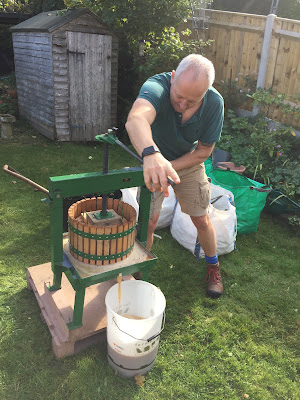
The Delicious Juice begins to Pour
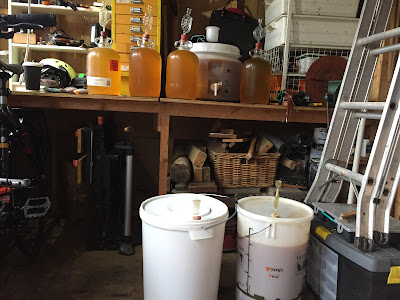
Then, one sunny weekend, Andy and I smashed, bashed, crushed and juiced the piles of apples and produced around 60 litres of delicious apple juice. It was a hard work,. but a nice (not to mention productive) way to spend the day. After our hard grafting we stored the juice in various buckets and jars in the garden shed, where it soon began to ferment into 60 litres of tasty cider. We aim to reduce this volume soon, it's taking up a lot of room in my shed!
Quite a Lot of Cider!
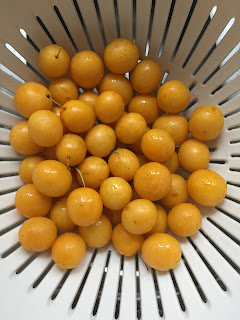
I also collected a good load of delicious yellow plums, which my daughter was more than happy to consume.

In November I started new employment, as a research technician at Southampton university. While wandering about during lunch hours, I kept an eye on the Medlar tree, situated near the Physics building, where I now work.
I have meddled with Medlars before, making wine and jelly but fancied something different this year. I gave a load to my friend Matt, who made nettle beer with me earlier in the year, and he produced a delightfully fruity Medlar Ale. I covered some Medlars with gin, in jars to supplement our Christmas Sloe Gin. We picked bags of Sloes during a much needed break on the Isle of Wight, and I can now testify that Medlar liquor is just as fruity as Sloe Gin, with a unique and distinctly different flavour and colour.

With my remaining Medlars, I produced Medlar fruit cheese or fruit leathers (as the recipe named them). Personally I don't think they bear any resemblance to cheese or leather, they are sweet, deliciously moist, very fruity, and they also keep remarkably well.