Monday, 28 March 2016

Nutty Flapjack / Museli / Energy / Snack Bars

We had two baskets of Hazelnuts and Walnuts that had not been used since Christmas. The nuts had been sitting, lonely on the side and I reasoned that we ought to be able to make some super tasty muesli/energy/trail/snack bars using some of them.
My daughter did a little research to make up a simple recipe that used up ingredients that we already had in our cupboards. I told her that she should improvise and replace one thing with another if necessary. Flour, rolled oats, butter and syrup form the base of Flapjack, and whatever else you add makes it more interesting, tasty and nutritious.
The following is what we ended up with and it worked fantastically using our nuts and some other simple things that we had available.
Ingredients
  • Self Raising Flour - 100g
  • Rolled Oats - 300g
  • Hazelnuts and Walnuts - 250g
  • Flaked Coconut - 50g
  • Sesame Seeds - 50g
  • Pumpkin Seeds - 100g
  • Raisins - 125g
  • Soft Brown Sugar - 200g
  • Butter - 200g
  • Golden Syrup - 125ml
Method
  1. Mix all the dry ingredients in a bowl.
  2. Melt the butter and syrup in a saucepan then allow to cool for 5 mins before mixing thoroughly into the bowl with a spoon.
  3. Using a baking tray about 2cm deep, line with greaseproof paper and then press the mixture into the tin.
  4. Bake in a pre-heated oven at 170 degrees Centigrade for 25 minutes.
  5. Allow the baked mixture to cool in the tin, it will be soft at first but will firm up as it gets colder.
  6. Cut the delicious flapjack into squares and eat.
It will probably keep for a week or so in an airtight tin but it will never last that long in our house!


Tuesday, 8 March 2016

Radioactive Spiders Not Required

Green Walnuts
A friend of mine recently enquired as to how I had secretly become an expert on fruit trees. He was not the first person to ask me this question, but the truth is, it does not take much time to learn the basics of tree identification. We already supply free, downloadable seasonal id pdfs on our blog and these sheets are also in the Urbane Forager book.
Anyone can learn to recognise a few tree species; you have to spend a while acquiring your skill but think of the benefits. It will be fun, satisfying and you could save a lot of money. You will spend more time outdoors and do more exercise, which is good for both your physical and mental health. Honing a new ability can be like obtaining a super power (only you don’t need to be bitten by a radioactive spider). 
The key to the Urbane Forager method hinges upon a few simple specific ideas.
Focus: We only bother to identify fruit and nut trees, those that will supply us with produce later in the year. This way, children (and adults) can be safely engaged and we do not have to worry about poisonous plants. You can see the main types of trees we pay attention to by looking at the id sheets page. Through time we have learned to spot other trees too, like Mulberries and Medlars.
Plum Blossom

Seeing: You have to actually see, not just look. It’s not difficult, but you do have to make a conscious decision to notice and log the things that other people choose to overlook. Observation is the fundamental weapon in any forager’s arsenal. The trees are ubiquitous, you just haven’t noticed them before.
Plums
Recording: Part of noticing things is remembering the locations, so write it down. We always use the Falling Fruit free access map, but a hand-drawn paper map is just as good. This way we can easily remember to go back and check the places that we might otherwise have forgotten.
Frequency: You need to be constantly moving, exploring, covering ground, walking or cycling around your area. We do spot trees when we go out on specific walks, but the majority I notice on my way to and from work or during my lunch time trips. 
Plum Blossom

I am a compulsive walker and get out of the office in all but the very worst conditions. I see the same things frequently and over time this helps me to tune into seasonal changes. You will not notice anything sat on the sofa watching TV.
Plums
Seasons: You need to observe the trees throughout the year. Spring is always a good place to start and it's coming soon. The different tree species come into boom in sequence, which is very handy. However, it’s no use noticing tree blossom during the Spring if you don’t know when it will produce delicious ripe fruit. Watching various species as they flower and fruit will reinforce your knowledge. Harvesting the bounty yourself on a sunny Summer’s day will really hammer that message home.
Of course, once you have made use of your new super power, you may well need to cultivate a few more skills. Depending on how much you pick, you might need to find an expert to help you store, bake, preserve, pickle, juice, freeze, or ferment your harvest. Alternatively, you could learn how to do this for yourself and that will be a whole lot more fun.

Thursday, 25 February 2016

Agglestone and Old Harry

It had been quite a bad week for us. Both children had gone down with a virus, which rather spoiled the school holidays for them. We had a couple of sleepless nights ourselves nursing the sick. 
Then, just as I was planning my birthday day out, I started to feel a bit poorly too. We were all a little run down; I wasn't quite laid low like the kids but I wasn't my normal perky self and my energy was quickly sapped.
However, we were not going to let a little virus stop our fun, I just had to moderate my ambition somewhat. I didn't go out with friends Saturday night, I got an early night instead and had a bit of a lazy Sunday morning. Then we fearlessly set out for Studland in Dorset, a beautiful stretch of coastline with miles of soft sandy beaches flanked by extraordinary white chalk cliffs.
Of course when visiting the beach in February in the UK you are not going to be packing swimming costumes and sunglasses, especially if you are not quite feeling yourself. The fringes of the Isle of Purbeck, as this area is known, are wonderful but they are only a tiny part of the appeal of the fantastic landscape. It is an absolutely fascinating place geologically and, as a result, historically.
I planned two short walks to exciting places, Old Harry chalk stacks and the astonishing Agglestone; I hoped that everyone, including myself, would be able to cope. Old Harry was first and it was blowing a gale when we tried to step out of the car in the National Trust car park. We started from the sandy beach but after a short while my daughters legs were going a bit wobbly, so she begrudgingly decided to turn back with Mum. 
No, You Cannot Walk Down There, Even If You Are Very Careful!
My son, who was now recovering, soldiered on with me and we were rewarded with the sudden and quite shocking view over the end of the path. He was permitted to carefully creep a lot closer to the edge than his Mum would have ever allowed. Having said this, neither of us ventured down to the very end of the suicidally sinuous path, that would have been highly irresponsible.
Pepped up by fresh air and the exhilaration of peering over the edge of the world, we set off down ancient holloways and across the sodden heath to hunt down the simply brilliant Agglestone.  We even spotted a group of Apple trees on our way.
From our first distant glimpse of the rock my son simply did not believe it, and thought initially that it was a tree. Later he said it looked like a giant broccoli stalk (it does) and renamed it the Brocclestone.
"The Brocclestone"
The Agglestone used to stand straight up but it did wobble and eventually it fell over, about 100 years ago. However, even lying down it is still a truly weird and wonderful piece of multi coloured, rippling rock. 
It does look alien, as if an asteroid dropped from space or a flying saucer landed and became fossilized. It sits atop its own special hill, standing out in the landscape as if deliberately placed there.
Many visitors have carved their initials and names in the soft sandstone around the base and it would be simple to say that this is a bad thing, but you can easily see the temptation. We decided to climb the Agglestone, it would have been a shame to get all that way there and not show our fascination for this beautiful geological beast in some significant manner.
We had to squint to stop sand blowing into our eyes and cling on like limpets to prevent ourselves being swept clean off. I let my son go first, he's a very good climber but I stayed very close behind him. We did quickly gain the summit without any trouble, then scrambled back down and victoriously squelched our way back to the girls.
We arrived in Studland via the millionaire's row of Sandbanks, a short-cut around the gigantic natural harbour of Poole but we returned via the ancient towns of Corfe and Wareham, tipping our caps to the castle on the way and stopping for well earned fish and chips in Southampton.
Because it was there! (Sandbanks in the background)

Friday, 12 February 2016

Early Spring? Make Mulberry Gin!

I found a big box of frozen Mulberries in our freezer yesterday. I gave a couple to the children as a chilly treat and then remembered that we had recently consumed the last of our super tasty Mulberry gin during the Winter nights. It was clearly time to create some fresh supplies.
My brother had given me a bottle of gin for Xmas and I was going to save it until the Summer months, but this seemed a project worthy of breaking that pledge. The decorative bottle that we had dispatched over Christmas was undoubtedly cute, but actually quite small, or so it seemed once we got a taste of it.
I filled too jars with the fruit and steeped it in gin; it soon took on a glowing ruby red hue. Normally when making liquors, I add a bit of sugar to help the process but Mulberries are so sweet, it did not seem necessary. I will test it in due course, just to be sure...
Spring seems to be arriving a full month early here in the UK. Plum blossom is blooming all over the place, snowdrops daffodils and crocuses are all flowering at the same time bringing a cheery flourish to the gloomy weather we have been experiencing.
Does this mean the Plums will be ripening a month early? Will they fruit before the Cherries? Perhaps February or March will turn dramatically colder and ruin the early harvest. Who knows? All we can do is wait and observe the changes as they occur. I remember a bad year for Cherries that I put down to high winds during the blossom season deterring pollinators.
Meanwhile, we can simply enjoy the florid display, allow it to lift our hearts and hope that it heralds a good Spring, warm Summer and prolific Autumn.


Friday, 29 January 2016

Blossom Sequence Mnemonic Competition

Now, there's a post title I didn't imagine ever writing, but you will be pleased to hear that there is a good reason for it. When Spring arrives, we always use blossom in the trees to help us easily locate and identify fruit trees. We then check back later to look for signs of maturing fruit.

To help remember the sequence that fruit trees bloom in we designed an acronym PBCAP (Plum, Blackthorn, Cherry, Apple, and Pear) Plum normally flowers around March (I have seen Plum blossom in January this year), the others follow in quick succession. The fruit of the Blackthorn is the Sloe so the B could be replaced with an S.
We remember this by using a mnemonic Perceived Blossom Calculates Abundant Produce but this is unwieldy. If you can think of a better one, send it in or write your comments below, the composer of the best will be duly announced and the lucky winner will receive a free copy of our beautiful book, the Urbane Forager: Fruit and Nuts for Free.
As a footnote I will remind readers that a mnemonic does not need to have anything to do with the subject matter, it only needs to be memorable. Richard Of York Fought Battle In Vain is a popular example for recalling colours of the rainbow or Naughty Elephants Spray Water for children learning the compass. So we could have Panthers Black Creep And Pounce or whatever

Sunday, 24 January 2016

Ice and Ancient Royalty

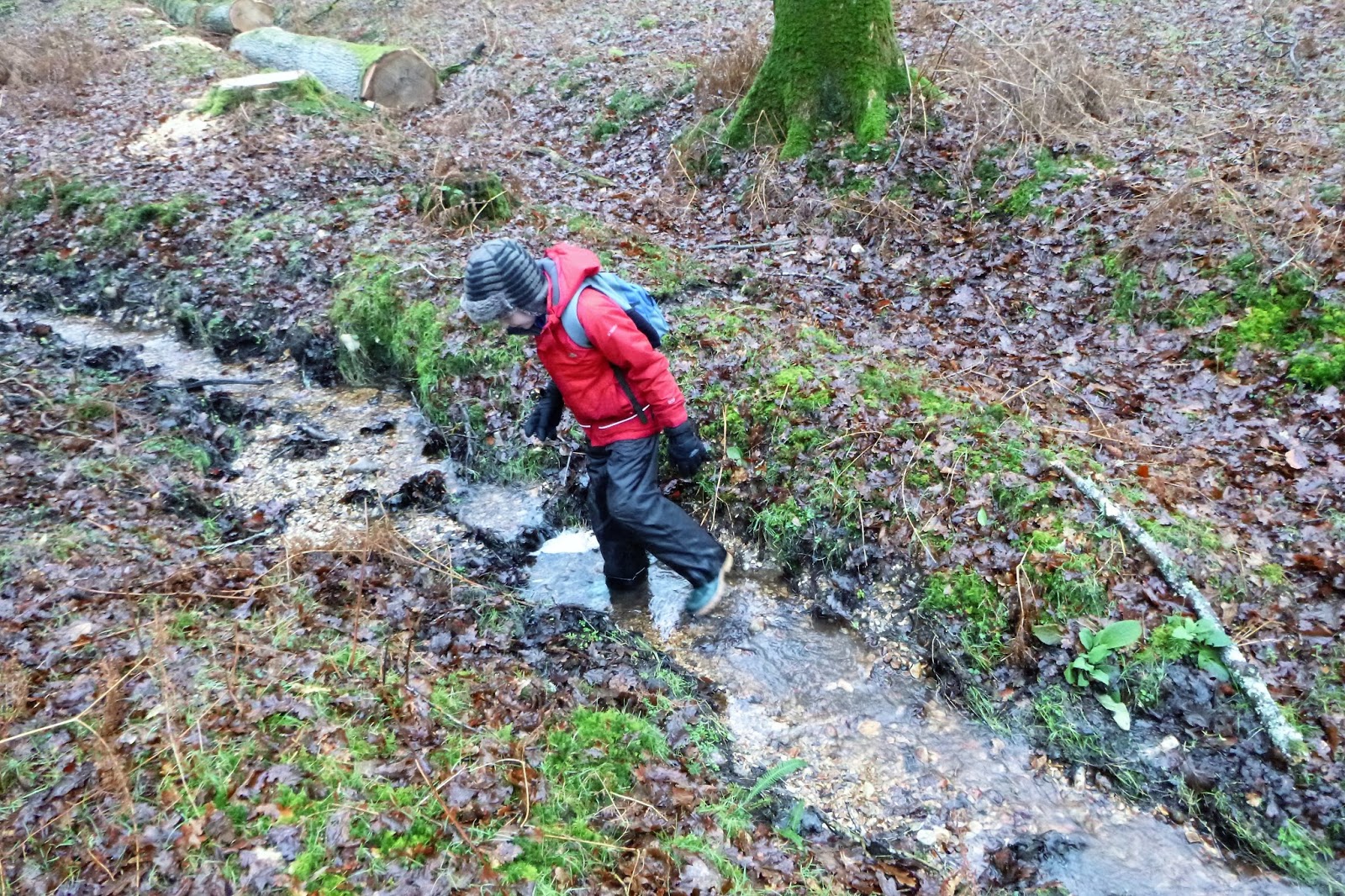
It had been raining hard, now it was freezing cold and the wind was howling, but a wise person once said that “there’s no such thing as Bad Weather, only inappropriate clothing!” With this in mind we layered up our clothing, got out our boots, waterproof jackets and trousers, located our hats and gloves and zipped out to the rain soaked bog that used to be the New Forest.
I always have a look at an Ordinance Survey map before we go for a walk. I normally try to find places along the route with quirky names, to amuse the children. My daughter once commented that I always take them to places named after the Devil, Hell or other gruesome things.* This is largely true but it’s not because I worship the Devil (I don’t).
On this little trip I  managed to find Deadman’s Hill, Claypits Bottom, Burnt Balls and the Butts (which did indeed made the kids laugh). I wanted to explore Studely Castle, the site of a royal hunting lodge. There are quite a few sites like this in the New Forest and they always seem to be in good locations - fit for a king, I guess. We did find the remains of the embankments and it commanded a great view. The children were duly pleased to know that kings had once tramped through the same sodden swamp that we had.
Once we got out of the woods the kids delighted in finding large sheets of ice, picking them out of puddles, then hurling them headlong to shatter, sending shimmering shards of ice, skittering across frozen water. Very entertaining! Their waterproof gloves were being sorely tested but it kept everyone happy and motivated to move on in the hunt for ice.
We only went as far as the Butts (a tumulus actually) before we felt the need for food and warmth, and started to think about heading home. Around here we found a nice frozen pond, which looked perilously dark and bottomless. We had to restrain the children from wading in too deep but it made a good full-stop for final ice smashing activities, before turning back along the boggy quagmire that was our path.

*As I explained to my daughter, this is due to the old Christian habit of renaming ancient pre-christian places of burial, worship or habitation as wicked or evil. Knowlton Henge is a classic example. Many churches were built on top of, or on the site of prehistoric antiquities, in an attempt to usurp the existing religious association. Twyford Church near Shawford was apparently built on top of a Stone Circle - and a Sarsen stone can still be found in the lane that leads up to it.  The Hell Stone is a Neolithic burial chamber and the Devil’s Coits is another Stone Circle.

Thursday, 14 January 2016

11¾ things to do before you're 50

This blog tends to focus on family activities, but that's because we have children. Obviously, there's no reason why singletons and couples cannot enjoy all the things we do too. Every now and then I think, why should the kids have all the fun? What about the hard working adults? Clearly, they deserve to enjoy themselves too.
With this in mind, I thought I would publish the Urbane Forager's guide to the 11¾ things to do before you're 50! Needless to say, you can still do them if you are older than 50.
For any children reading this, the before you're 50 bit means that you can help your parent's in the identification, mapping, picking and preparation of these various concoctions, the alchemy of fermentation is a fascinating science lesson. However, you should not try drinking alcohol until you are old enough; you would most likely think it tasted horrible anyway.
1. Notice the first blossom of the year in the hedgerows, this will be the Blackthorn (Sloes) and Plum trees, remember where it is and add the locations to the Falling Fruit map. Check back later to pick the fruit. Plums ripen around June/July but you will need to be much more patient with the Sloes.
2. Make Elderflower Champagne, cordial is a big favourite for the children too. The Elder bushes herald the onset of Summer around May/June, depending on global warming. Remember to use pressure-safe bottles! Also, remember where the bushes are and return later in the Summer for Elderberries.
3. Pick and eat Cherries straight off a tree. What could be better? Spot the Cherry blossom when it arrives after the Plum and Blackthorn, record the location on the Falling Fruit map. Cherries will be the first fruit to ripen in the UK and you will need to be quick because the birds like them too!

4. Observe Apple and Pear blossom while the Cherry blossom is turning into immature fruit. Note the locations on the Falling fruit map (can you detect a theme building here?). Nothing beats climbing up and picking Apples fresh from the trees; they obviously make the most delicious and healthy snacks and will keep for months. You can also press the apples into  the best tasting juice or turn it into gallons of cider for virtually no cost whatsoever.
5. Have a competition to see who can pick the most Blackberries. Blackberries grow almost everywhere but it's nice to get out of the city if you can. Everyone can stuff there juice smeared faces with fabulous fruit and when you return you can freeze the remainder or use them to make fantastic vodka and gin based liquors, fabulous to break out later on after a Summer BBQ.

6. Find a Mulberry tree, if you cannot find one, plant one. I try not to tell anyone where my favourite Mulberry trees are; it's good to keep some tree locations secret. The kids go crazy over this sweet sticky fruit and I always Mulberry Gin (can you see another theme developing) along with various puddings. I still have some in the freezer...

7. Make Elderberry wine. The berries will be abundant around August and making this archaic and intoxicating brew is a very simple and satisfying process; you can watch it bubbling away and then save it until it matures. I always use some to make bottles Mulled wine around Christmas, always a good thing to take to parties, along with the mince pies.
8. Find a Walnut tree; there's bound to be some somewhere in your vicinity. Walnuts ripen along with Hazelnuts around September but you can pick exotic smelling Green Walnuts earlier (in June) if you want to try pickling, making Schnapps or Vin de Noix.

9. Gather a great load of big, fat Chestnuts and roast them over a fire, we use a BBQ or chimenia because of our small garden. It's a great way to warm up and celebrate Autumn. Also roast Chestnuts make an ideal accompaniment to fireworks on Guy Fawkes Night. Don't forget to prick them first!

10. Make Sloe Gin. A very simple process, resulting in a fantastically plummy tasting liquor that is just the ticket for those chilly, dark Winter nights and also make the perfect Christmas gift for family and friends.
11. Bring the love into your house! Find and cut a big bunch of Mistletoe. Actually, it is easy to find and more complicated/dangerous to collect but with a little ingenuity and improvisation it is possible. Your loved ones will hopefully be delighted and you can give some to friends and neighbours too.

¾. Upcycle the left-over gin-soaked Sloes that you used to make your Sloe gin (10) use some to spice up your Mulled Elderberry (7) wine or to include in your home-made Christmas Plum (1) pudding.